
Do Higher Art Class Prices Hurt Enrollment? New Original Research


Do higher art class prices hurt enrollment? What 11,000 classes show
For arts organizations running education programs, classes and camps are often both a revenue line and a community access tool. When it comes to pricing, organizations have to consider accessibility, enrollment goals, community relationships, and whether they can cover the rising cost of instructors, materials, facilities, and equipment.
Weighing all of these factors is tricky and it doesn't help that leaders often find themselves relying on hunch instead of solid data to make these decisions.
That's why we built this report.
We analyzed more than 11,000 arts and culture classes from organizations across the United States to understand how arts and culture organizations are actually pricing classes today and how price impacts enrollment.
The results suggest that higher prices do not automatically lead to lower enrollment. But the relationship between price and demand looks very different depending on what you teach, how the class is structured, and how clearly participants can see its value.

Key finding: The typical art class costs $17.50 per hour
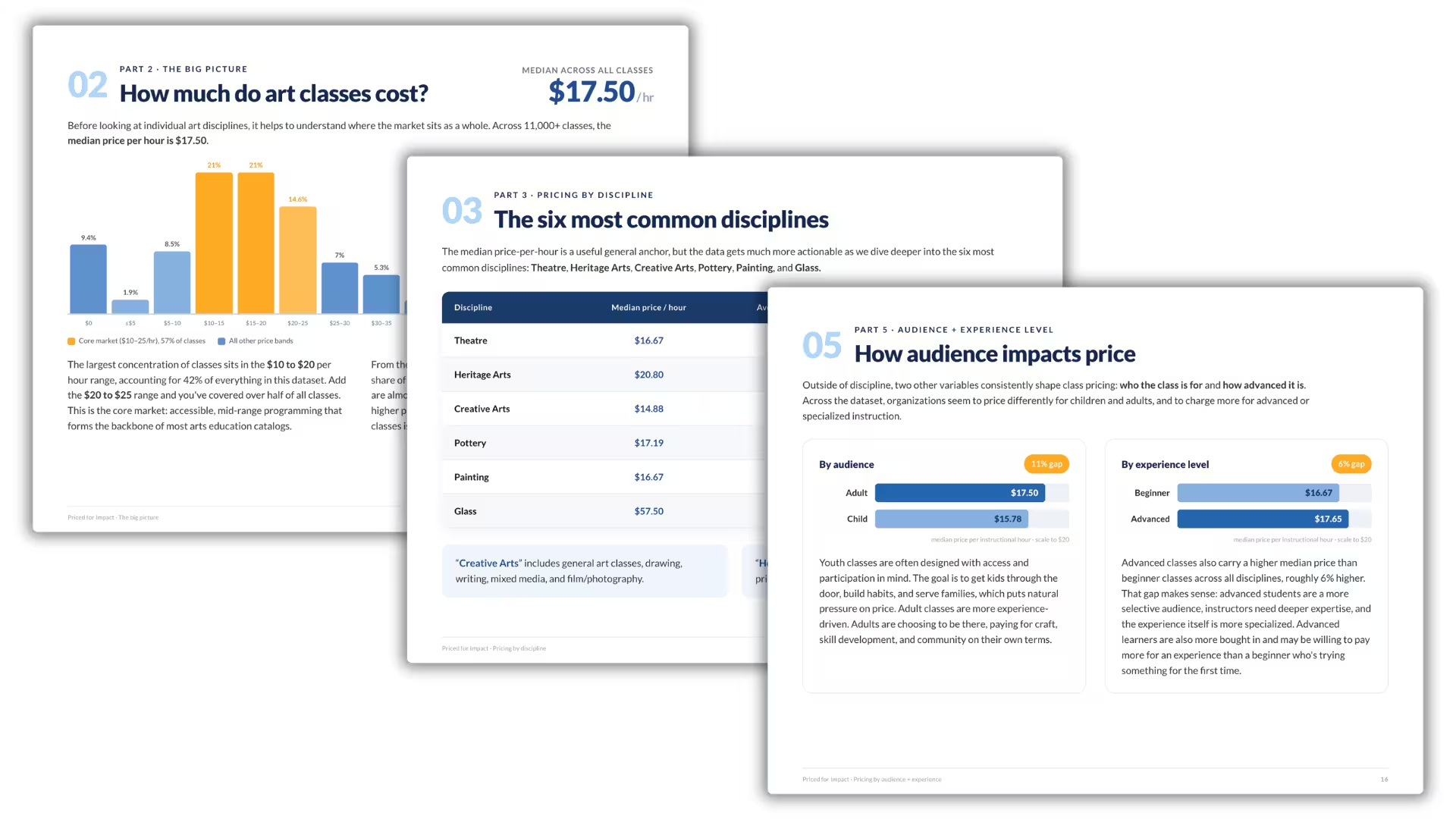
Across our entire dataset, the median price-per-hour is $17.50.
The largest concentration of classes sits in the $10 to $20 per hour range, accounting for 42% of everything in this dataset. Add the $20 to $25 range and you've covered over half of all classes. This is the core market: accessible, mid-range programming that forms the backbone of most arts education catalogs.
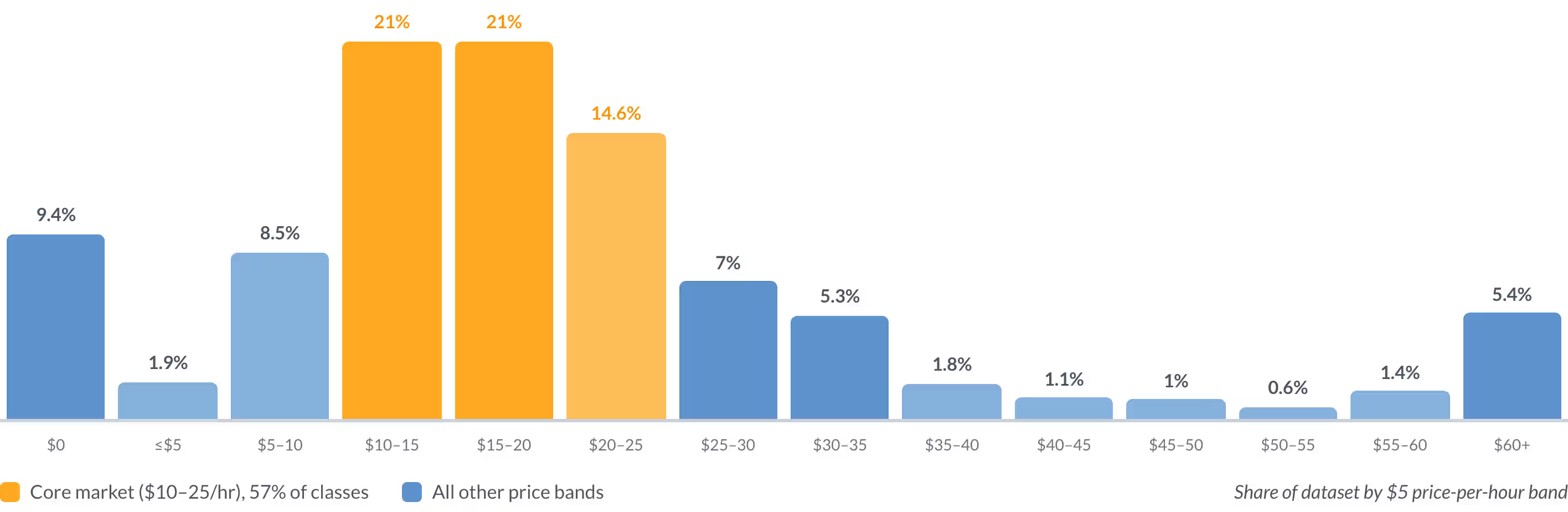
A small share of classes, roughly 5%, are priced above $60 per hour; these are almost always short-form classes (under one hour) with a higher price tag. At the other end of the spectrum, nearly 1 in 10 classes is offered free—often a reflection of organizational commitment to mission and community access.
A note on the data: For this report, we normalized all class prices to a price per instructional hour vs. class list price. That way, we could compare classes of different lengths and formats on equal footing. When you're comparing your own class prices to the benchmarks in this report, you'll want to first convert them into a price per hour.
Key finding: Median price by discipline
The median price-per-hour is a useful general anchor, but the data gets much more actionable as we dive deeper into the six largest categories in our dataset: Theatre, Heritage Arts, Creative Arts, Pottery, Painting, and Glass. Median price-per-hour varies across these six categories:
- Theatre: $16.67 per hour
- Heritage Arts: $20.80 per hour
- Creative Arts: $14.88 per hour
- Pottery: $17.19 per hour
- Painting: $16.67 per hour
- Glass: $57.50 per hour
"Creative Arts" includes general art classes, drawing, writing, mixed media, and film/photography. "Heritage Arts" includes craft and maker classes, such as printmaking, book arts, woodworking, jewelry, and mosaic.
Key finding: How price impacts engagement across disciplines
If we raise prices, will people stop signing up? This is the key question for program managers considering a pricing change. Our data shows that higher class prices do not automatically mean fewer signups but there is strong variance between disciplines.
To determine engagement, we divided class prices in each discipline into four pricing quartiles: Lowest, Lower-mid, Upper-mid and Highest. We then looked at fill rate and sold-out rate across each quartile for each discipline. Fill rate refers to the percentage of available seats that were filled: A class with 10 seats and 8 registrations has an 80% fill rate. Sell-out rate is the share of classes in that category at that price tier that reached full capacity.
Theatre classes: Strong price sensitivity
In our dataset, theatre classes show the clearest negative relationship between hourly price and demand. Median fill rate falls from 87% in the lowest price quartile to 50% in the highest. Median enrollment also drops from 14 to 7, and sell-out rate falls from 37% to 14%.
This doesn't mean theatre programs can't charge premium prices. It does mean that higher-priced theatre classes may need a particularly clear reason for participants to pay more. Premium pricing is easier to support when a class includes benefits such as:
- Audition preparation
- Performance opportunities
- Individual or small-group coaching
- Production experience
- A recognized or specialized instructor
- A clear pathway to skill development
Heritage Arts: High demand at high prices
Heritage Arts, on the other hand, shows a positive relationship between hourly price and demand. Median fill rises from 50% in the lowest quartile to 86% in the highest quartile, while sell-out rate rises from 13% to 45%. Notably, median enrollment is consistent across all quartiles, indicating standard smaller class sizes in this category.
Program managers shouldn't assume Heritage Arts must be priced as an access category. Where materials, specialized equipment, cultural context, instructor expertise, or a finished object create clear value, test premium positioning. Compare performance within similar crafts and class formats so that differences in capacity and materials do not distort pricing decisions.
>> Get the full report for to see how price impacts engagement in Creative Arts, Pottery, Glass, and Painting
Key finding: Price higher for adult & advanced classes
Outside of discipline, two other variables consistently shape class pricing: who the class is for and how advanced it is. Adult classes have a median price per hour that's 11% higher than children's classes, while advanced class prices sit 6% higher than beginner classes.
These gaps make sense. Youth classes are often designed with access and participation as the goal, while adult classes are more experience-driven. Advanced learners are likely more committed to developing their skills and more willing to pay a higher price versus beginners who are trying something for the first time.
Six steps to the right price
The report also includes a 6-step pricing framework designed to help you use your own historical pricing data alongside the benchmarks in this report to find your art class price sweet spot:
- Calculate your minimum viable price: This is your price floor—class prices shouldn't dip below this
- Establish a market anchor: Blend your historical pricing with the benchmarks in this report to find your anchor
- Adjust for demonstrated demand: Let fill and sell-out rates guide how you adjust pricing
- Adjust for premium value: Charge more when the value is visible
- Refine for audience, skill level: Factor in who a class is for and how advanced it is
- Test, measure, review: Treat price changes as experiments
>> Get the full report to access the complete framework with formulas and examples.
Set your prices where three factors overlap
Many arts organizations underprice classes, especially relative to their own increasing costs and what the market will actually bear. Plan to review class prices annually if possible and set your prices where these three factors overlap:
- Financially sustainable: Covers the cost and revenue needs of the program
- Market aware: Reflects comparable classes and market benchmarks
- Value-aligned: Makes sense for the audience, outcome, and experience
A defensible price is sustainable, market-aware, and value-aligned. The benchmarks in this report and the first few steps of our pricing framework will help you understand factors one and two. The third you have to communicate, and that's the work most often left undone. When participants see and understand the value they're getting, the price tag becomes a much smaller factor.

Save time and grow your impact with CourseStorm

