
3 Templates to Build Buy-in for Your Nonprofit Art Education Program


You’re working hard to build a strong arts education program. Classes and camps are running and sign-ups are coming in. On paper, it looks like things are working.
But something feels off.
Maybe your board isn't quite bought in on the opportunity around education. Maybe staff are stretched thin or quietly disengaging. Maybe families are enrolling, but not as many as you’d hoped.
The program exists, but the support around it doesn’t feel as solid as it should.
In nonprofit arts, education program success depends on people across the organization working in sync. Boards influence program budgets and resource prioritization. Staff and volunteers handle class registration, communication, and day-to-day operations. Instructors and teaching artists determine the in-class experience. Families and patrons decide whether to enroll, return, and recommend your classes to others. Each group shapes your program’s success.
When everyone understands and believes in the education program, it becomes a real engine for your organization. It advances your mission, brings in revenue, and keeps your community engaged beyond performances. But gaps in understanding and support make even strong programs harder to sustain.
When everyone understands and believes in the education program, it becomes a real engine for your organization. It advances your mission, brings in revenue, and keeps your community engaged beyond performances.
In this article, we’re sharing three evidence-backed templates you can use to help your board, staff, and community better understand the value of education and champion its role across your organization. Together, they offer a practical way to keep your education program thriving.

A Board-Ready Framework for Art Education Program Support
Board support can make or break an art education program.
Nonprofit boards define priorities, approve budgets, and help decide what initiatives stay or go when resources are tight. At the same time, most board members experience programming from a distance. They see reports, numbers, and occasional updates, not registration crunches or classroom moments.
Building buy-in starts with speaking your board’s language.
Building buy-in starts with speaking your board’s language. They need to clearly see 1) where education fits, 2) why it matters, and 3) how it supports the organization as a whole, so they can confidently support it.
What Matters to a Nonprofit Arts Board
A nonprofit board’s contributions are often described with a simple shorthand, the 3 Ws or 3 Ts:
- Work / Time: Strategic involvement through committees, planning, and problem-solving.
- Wealth / Treasure: Financial support through personal giving, fundraising, and budget oversight.
- Wisdom / Talent: Professional expertise and community perspective that inform strategy and governance.
They tend to evaluate programs from a big-picture perspective. Since their responsibilities include stewarding your mission, overseeing financial sustainability, and protecting your organization’s standing in the community, they pay close attention to how the education program supports strategic priorities.
What Gets in the Way of Board Support for Education
Across nonprofit arts organizations, a few common patterns show up again and again.
Missing context around education programs
Many board members are volunteers who don’t get much training on how board are expected to operate. Without a clear, shared understanding of how education programs work, what they need, and what success looks like, boards often default to familiar ground like budgets and fundraising rather than engaging with education strategically.
Fundraising pressure crowds out program understanding
A recent survey found that nearly 50% of nonprofit boards require members to fundraise. On those boards, 90% of respondents said that responsibility was as important as, or more important than, their other duties. As a result, short-term fundraising goals can take priority over investing in education programs, despite the near- and long-term value these programs create.
Financial uncertainty increases risk aversion
Arts and cultural organizations experienced an average 25% decline in revenue from 2023 to 2024, with inflation-adjusted revenue down 36% since 2019. In this climate, boards naturally prioritize stability and risk management, which can make sustained investment in education programs harder to justify without precise framing.
How to Build Board Buy-In for Your Art Education Program
Building buy-in works best when you treat it like a long-term relationship. Start by understanding what motivates your board members. Build trust by sharing context and being honest about what’s working and what isn’t.
From there, focus on consistency and visibility.
- Share a quarterly or bi-annual program performance snapshot with your board. Provide a quick view of participation, financial health, and community engagement numbers. Tie any outcomes directly to strategic goals the board already tracks, like revenue contribution and reach.
- Balance data with impact stories. Use individual participant stories to connect with board members on an emotional level, then anchor those stories with numbers the board recognizes and trusts.
- Show and tell. Invite board members to a class visit or student showcase that brings the program to life without adding work.
"One of the biggest ways we share impact is through stories. As much as numbers drive things, we really try to show impact by storytelling whether that's with quotes or stories from our students, our parents, or our teachers about their experience." – Craig VanRenterghem, Director of Education at Marathon Center for the Performing Arts
Over time, clear expectations, consistent communication, and mutual accountability help board support stick.
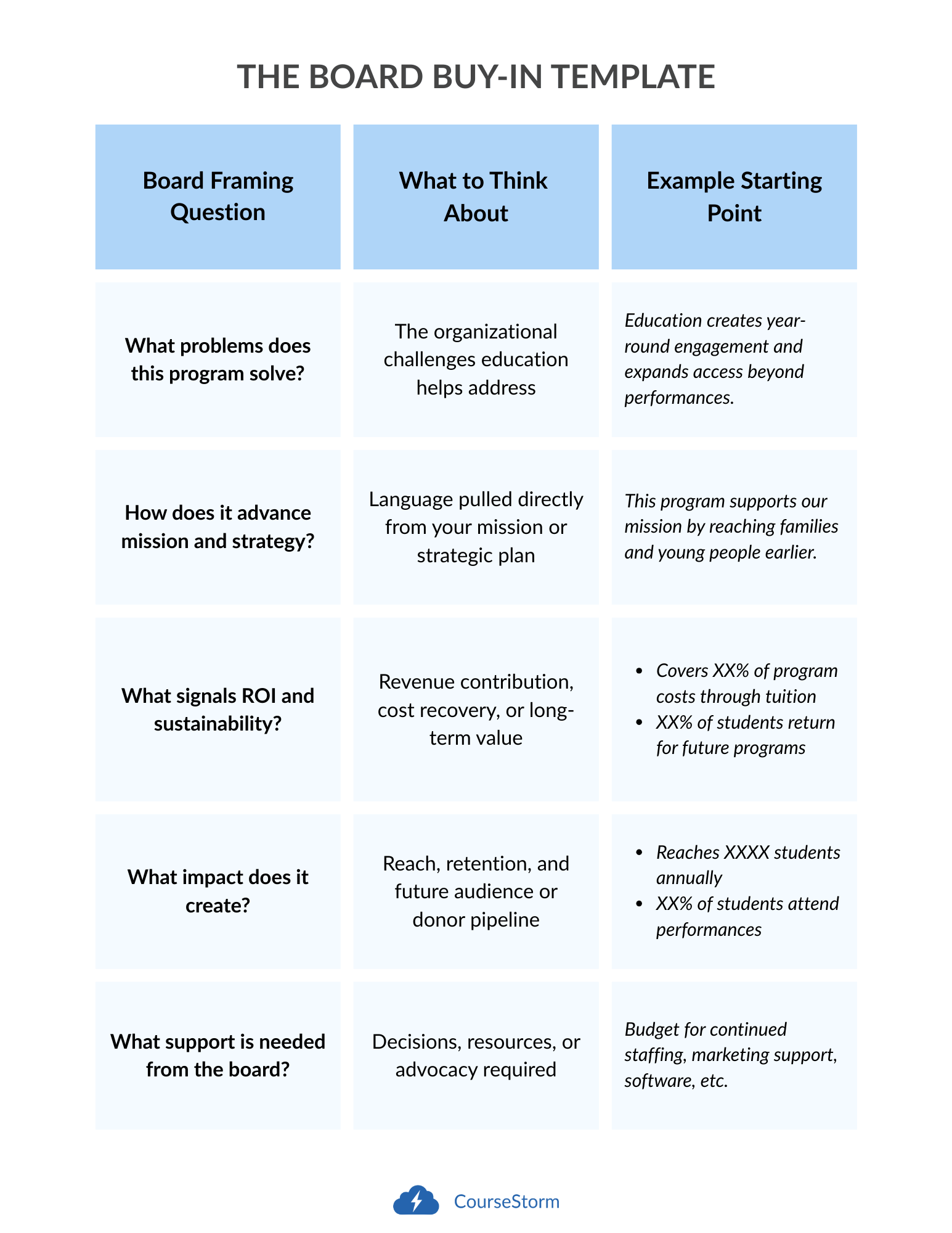
The Board Buy-In Template
Use this template to reflect on and showcase your art education program in a way that will resonate with your board.
Making Art Education Work for the People Running It
You can usually feel when staff engagement is slipping. Launching classes feels like a scramble instead of a celebration. Teaching artists seem disconnected from the rest of the organization. Marketing promotes classes sporadically and without clear priority. None of it is dramatic on its own, but it adds up.
Staff, volunteers, and instructors each experience your program from a different angle. When systems create extra work or the impact feels distant, engagement drops which can prevent your program from taking off. In this section, we'll explore how to keep staff excited about your education program so it can flourish.
What Staff, Volunteers, and Instructors Care About
As you well know, most people working in nonprofit arts already care deeply about the mission. It's rarely a question of wanting to do the work.
But there are undeniable realities of working in an arts nonprofit. Things like funding instability, constant advocacy, and wearing multiple hats—and these pressures compound over time. Education programs also introduce ongoing registration, staffing, and communication demands.
So, given these challenges, what are the most important things we can do to support staff and sustain long-term commitment?
According to a 2026 Spektrix and INTIX report, arts professionals said the changes that would most improve their day-to-day work are:
- Better collaboration and communication
- Greater efficiency and impact
- Clearer organizational goals and priorities
That aligns with much of the writing on engagement and with what many arts leaders see firsthand. People stay engaged when they feel listened to, trusted to do the work, and recognized for it. Those fundamentals are what feed motivation over time.
Why Staff Disengage From Education Programs
Staff disengagement rarely comes out of nowhere. It usually follows a few predictable pressure points.
Workload spikes and burnout
Anticipated workload spikes are manageable. Unplanned spikes and consistent overwork drain teams fast. A 2024 report found that 95% of nonprofit leaders are concerned about staff burnout, and another reports that over 60% of nonprofit workers experience demanding workloads often or always.
Manual admin and technology debt
Poorly supported processes turn meaningful work into administrative overhead. Nearly half (45%) of nonprofits say they’re spending too little on technology. That extra manual effort chips away at motivation over time and can end up costing an organization more than it saves, including hours, turnover, and a poor customer experience.
Lack of stability for instructors and teaching artists
Teaching artists often juggle multiple gigs. According to Theatre Communications Group, 73% of theatre workers have considered leaving the field or have already left due to financial constraints. Uncertain pay or inconsistent contracts often push instructors to step back, even when they care deeply about the work.
How to Build Staff Buy-In for Your Art Education Program
Staff buy-in for your education program usually breaks down when day-to-day work feels messy, disconnected, or opaque.
A staff member stays late during registration week to correct incomplete forms. An instructor shows up without the full class list. A volunteer answers the same parent question three times because the info wasn’t on the website.
And if people can’t see how what they’re doing connects to what the program is trying to achieve, that manual effort can start to feel particularly thankless or inefficient.
Buy-in grows when each person has the right information, at the right time, to understand their role and why their work matters.
A few practical moves that make a difference:
- Understand where time is going. Identify where staff are spending extra time coordinating, fixing, or following up.
- Standardize the basics. Transparent processes, shared documentation, and consistent handoffs reduce confusion across roles.
- Reduce manual work where possible. Use systems that minimize duplicate data entry and list wrangling so staff can focus on participants.
- Make impact visible. Share regular updates that show how staff contributions are impacting your community and your program’s success
- Set clear expectations up front. Be explicit about your mission, the workload, and level of support when onboarding instructors and volunteers.
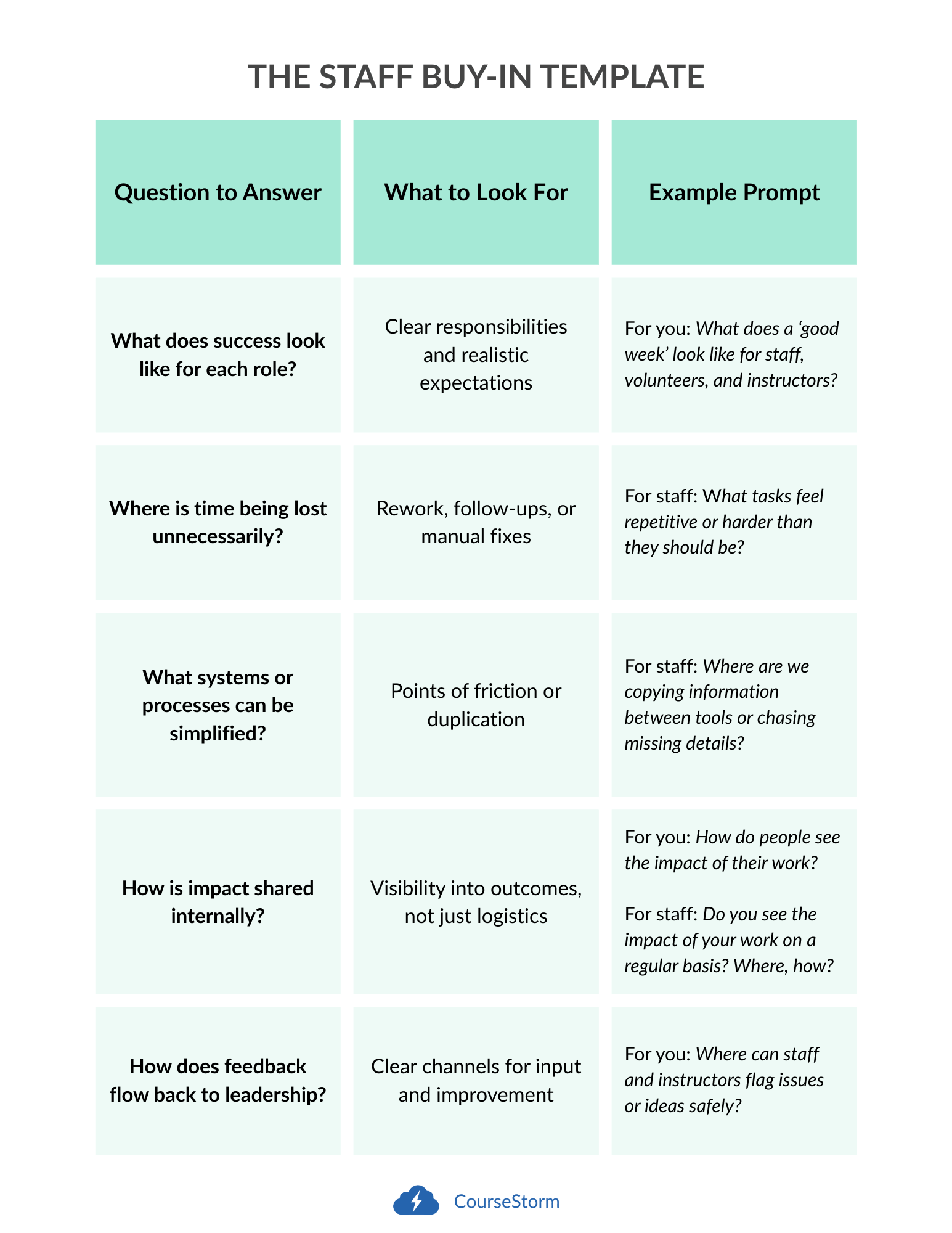
The Staff Buy-In Template
Use this template to see how your art education program is impacting the people running it. It works well as a planning tool, a retrospective after a busy registration cycle, or a prompt for team conversations.
Community Buy-In Starts Before the Classroom
It's no easy feat to run an arts education program. You and your team are juggling expectations, budgets, systems, and a hundred small decisions everyday that keep things moving.
But community members don’t see most of that. Their view of your program usually comes down to a few simple questions:
- Is this easy (to find, understand, do, etc.)?
- Does it fit my life (my schedule, preferences, and needs)?
- Do I trust this organization (with my time, my family, to deliver)?
This section examines how the two perspectives differ and why starting with what communities care about helps build stronger support.
What Your Community Needs to Say Yes to Your Program
For families and patrons, first impressions matter, well, first. Then, it's about how you show up consistently.
At first, people are most likely looking at the basics: what the class is, who it’s for, when it runs, how much it costs, and how hard it is to sign up. They may be evaluating a few options in the area and deciding which one works best.
That’s why clarity and ease matter so much. Clear outcomes help people understand what they’ll gain, and straightforward registration, course descriptions, and predictable schedules reduce friction.
Over time, trust is what keeps people coming back. Consistent experiences, credible instructors, and a reputation for follow-through all add up.
"Our program is successful because we prioritize consistency, dependability, and trust. We hear over and over that families are pleased with what we do, that they feel comfortable dropping the kids off and going about their day." – Anne Hering, Director of Education at Orlando Shakes
Why Education Programs Struggle to Grow Participation
We speak with arts organizations everyday and, when it comes to growing education program reach, we hear a few common roadblocks:
Low visibility outside your core base
Programs exist, but people unfamiliar with your organization never see them. Discovery depends too heavily on word of mouth or a single channel.
The message gets stuck on logistics
Details such as dates, prices, and age ranges dominate, while outcomes remain vague. People can’t tell what they’ll actually gain.
First steps feel intimidating
Complicated systems can create unintentional in-groups. If someone doesn’t already “know the ropes,” registering for a class can feel like walking into a room where everyone else got the memo. That moment alone is often enough to make people second-guess whether the program is really for them.
There’s no obvious next chapter
A great first class ends, and then… nothing. Without a clear pathway, interest fades instead of turning into ongoing engagement.
How to Create and Sustain Community Buy-In
Community buy-in grows the way habits do. Make it easy to start, rewarding to repeat, and hard to forget.
Here are a few tactics your organization can use to grow education program engagement:
- Lower the barrier to entry. Introduce targeted discounts to audiences that could influence families in your community such as teachers and librarians.
- Be strategic about visibility. Offer free tickets to educators on low-sales nights, building goodwill while also collecting contact info to promote classes, summer camps, and youth programming.
- Double down on the in-person impression. Make meaningful connections when people are at your space; create a great experience and advertise other opportunities.
- Create clear return paths. Send follow-up offers to new students after their first class, such as a series discount or priority registration.
- Design for real family rhythms. Parents plan weeks, sometimes months, ahead. Predictable flagship programs and early-bird incentives help them fit your classes into their calendars before life fills the gap.
- Stay top-of-mind without adding work. Use automated reminders to keep education offerings visible between sessions, without relying on manual outreach.
"Our strategy has been really to make sure that we're trying to have a presence in people's digital lives but also still a really warm and welcoming presence when we get them in the door." – Owen Smith, Producing Artistic Director at The Playhouse Stage
These tactics broaden your audience-base and build long term familiarity, trust, and loyalty in your community. And that means consistent, sustainable program growth.
The Community Buy-In Templates
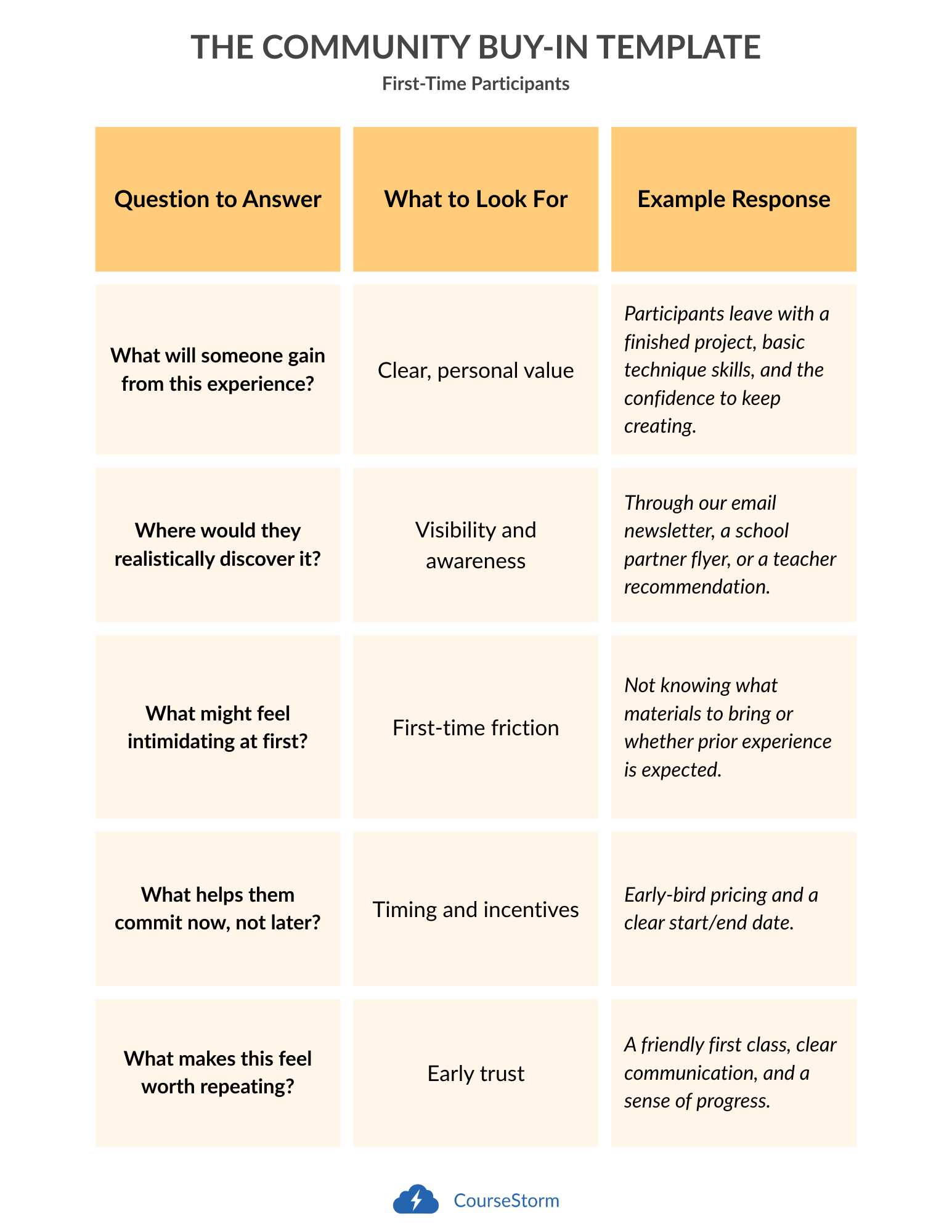
First-Time Participation Template
Use this template to understand how someone decides to try your art education program, and to shape the experience around those decision points.
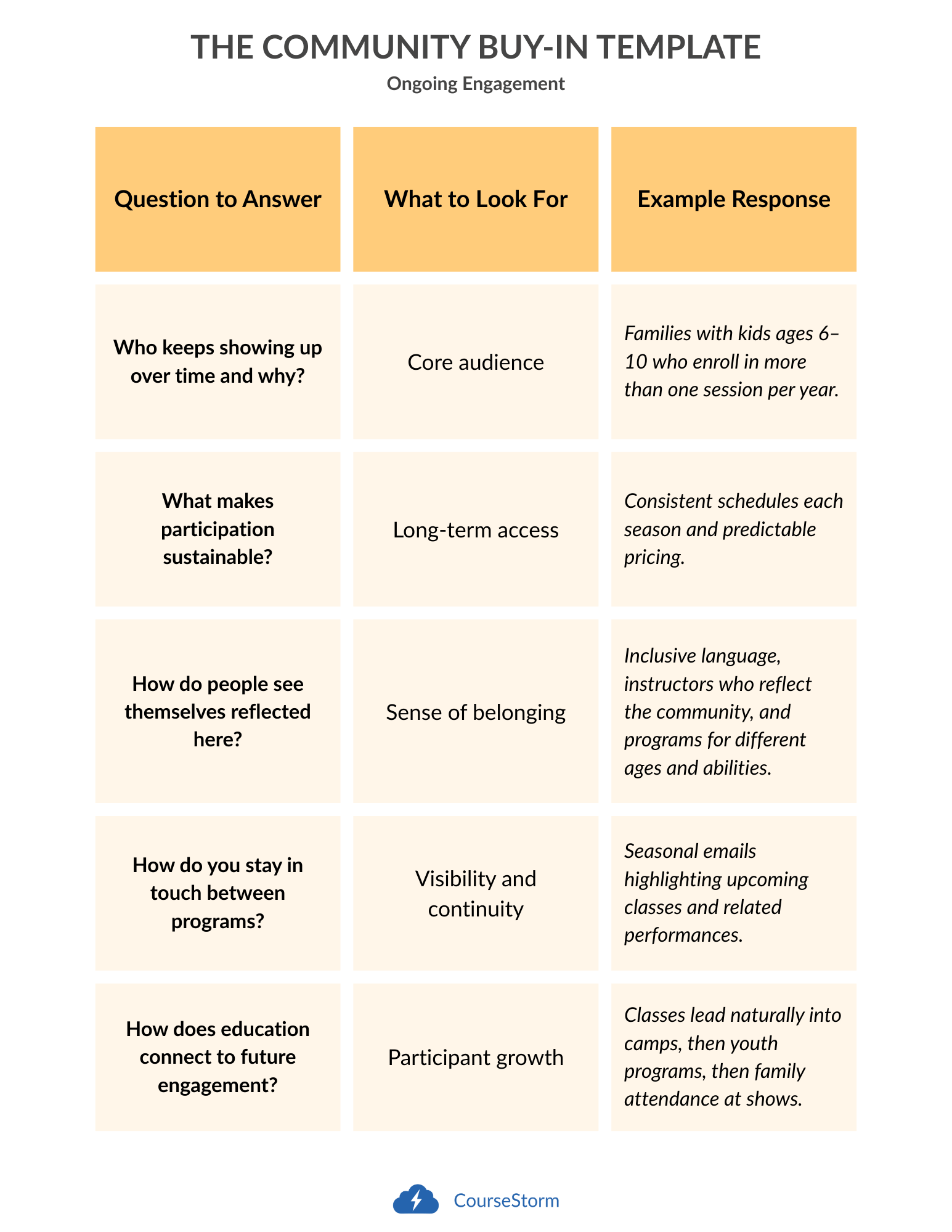
Ongoing Community Engagement Template
Use this as a planning tool to think through how your education program supports repeat participation, trust, and long-term relationships with your community.
Building Buy-In is a Long Game
Education program buy-in isn’t something you lock in once and move on from. You build it through regular communication, shared context, and showing people how education fits into the bigger picture.
If you want to build an education program that lasts, getting and maintaining buy-in from your board, your team, and your community is essential. Each of these groups require a slightly different approach, but the core of the story is the same: sharing why education matters to your organization and community and showing folks how they’re contributing to that impact.
The tools and templates in this article are a starting point. Used consistently, they can help you create clearer conversations, reduce friction, and keep education top-of-mind.
Related reading: Want more content to help you build an arts education program that feeds your entire organization? Check out our 5 Pillars to a Thriving Arts Education program guide chock full of best practices and real-world examples.
Save time and grow your impact with CourseStorm

