
How Red Mountain Theatre is growing their education program and creating better humans



“Education isn’t an ‘aside’ for us,” explains Drew Francis, Managing Director at Red Mountain Theatre. “It’s part of the core of what we’re doing.”
Red Mountain Theatre (RMT) is a nonprofit theatre in Birmingham, Alabama focused on fostering artists, inspiring youth, and engaging audiences through quality theatre and education programming. Each year, they put on 5 mainstage productions and offer over 80 classes and camps, 10 weeks of summer camp programming, as well as performing and young artist ensemble programs.
Their ultimate goal is simple: Make better humans.
“We’re not just trying to produce Broadway-caliber students,” says Drew, “we’re producing doctors, lawyers, teachers, bus drivers, people who become better humans.”
That focus and approach is working. From 2021 to 2025, Red Mountain Theatre has grown its performing arts education program, both in terms of enrollments and revenue, by nearly 60%. In this article, we explore the core tenets that support RMT’s education program success.
1) Treat education as a key tent pole, not an add-on
As Drew said, education is a core part of the “reason for being” at Red Mountain Theatre. In fact, education and youth development are called out in the organization’s vision statement:
We believe arts education inspires skills necessary for all youth development. Through theatre, students sharpen their ability to create and to collaborate, gaining confidence along the way. These skills serve students beyond the stage.
Education is also championed by both the administration and education teams and has leadership-level representation. The department is overseen by RMT’s Artistic Director (who also happens to be a professor at the University of Alabama at Birmingham). With education embedded in RMT’s vision and championed across teams, it’s an undeniable organizational priority.
If, for example, a one-time venue rental might generate more immediate revenue than a class in the same space, RMT is able to prioritize the class because it is understood—across the organization—that education is mission critical. This ensures the program is protected, prioritized, and resourced so it can flourish and expand its impact.
Steps to make education an organizational priority
- Identify the executive-level champion (or champions!) for your education program and make sure that person is in the right rooms, a part of decision-making conversations.
- As the program owner, make it clear how the education program links to and advances overall organizational goals. If your organization has a 1-year plan, for example, waterfall education program goals directly from that plan.
- Show the impact of your education program with both data—enrollment numbers, sell-out rates, etc.—as well as stories that capture the personal impact the program is making in your community
Related reading: 3 templates to help you build support for your education program at the board, staff, and community level
2) Build around how your community wants to participate
The Red Mountain Theatre education program started with youth camps and performing ensembles. As their community participated in these programs more and more, the RMT team got feedback that helped them build out their offerings.
First, they expanded with youth classes focused on particular theatre skills, such as acting, singing, and technical theatre. Recently, they’ve begun to add adult classes; participants can purchase a bundle of classes or drop in as long as there is availability. This addition is a direct response to requests from their community and an understanding of the potential revenue opportunity. But the listening doesn’t stop there; the team is tuned into enrollment data and what they’re hearing from participants.
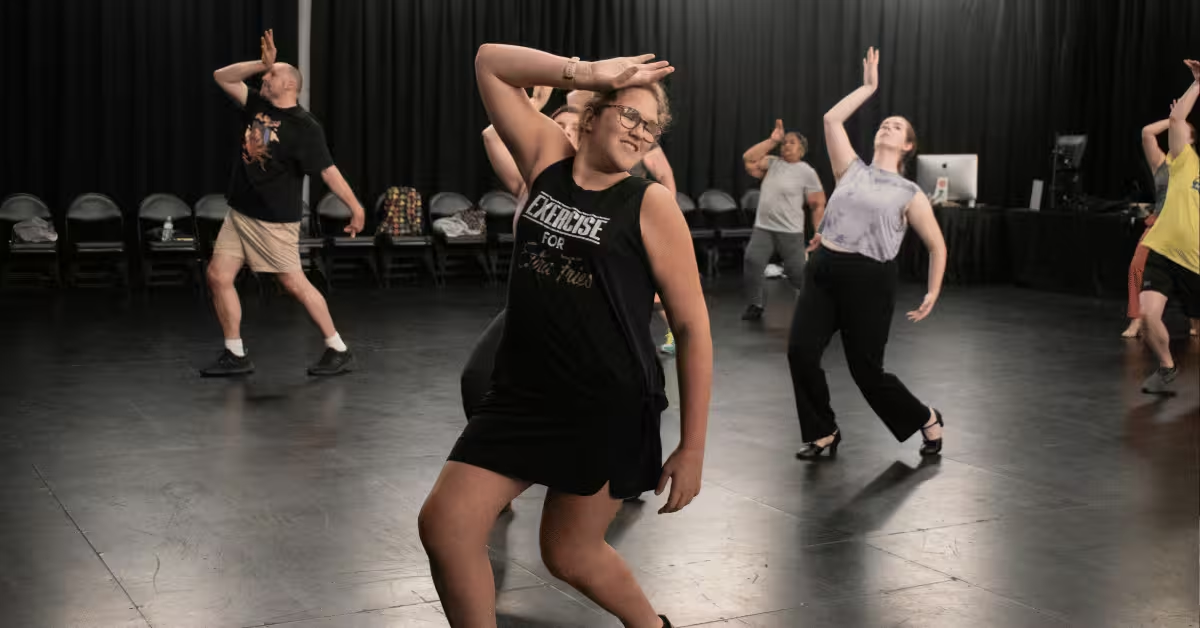
For example, enrollment data showed that adult acting and improv classes were performing well. Adult dance classes, on the other hand, needed some support. The team hypothesized that the value proposition needed fine tuning. Adults may not be signing up for a musical theatre dance class to gain musical theatre dance skills. Instead, they may resonate more with a promise of movement, fun, exercise and connection. The team is now leading with this messaging to see if they can improve dance class enrollment rates.
Steps to connect your offerings to your community
- Look at your enrollment data to compare cycles, particularly your fill rates—the percentage of available seats that were filled. Know which classes fill and fill fast, and which classes struggle. For the classes that struggle, diagnose and iterate where possible.
- Collect qualitative feedback via feedback forms, in-class discussions, and community conversations. Be present and listen to what people are asking for and what they’re sharing about their experiences.
- Know your community, both in terms of demographics (young families, older adults, etc.) and overall characteristics (local industries, local traditions, etc.). Plug in to people and partnerships to stay in the know so you can tailor classes appropriately.
3) Summer camps are an entry point, not the final destination
Each year, over 1,000 students participate in Red Mountain Theatre’s summer camps which run over the course of 10 weeks. Camps are far and away their most popular program in terms of participation. However, Drew notes that the students and families that engage with summer camps are different from those who engage with their year-round performances and programs.
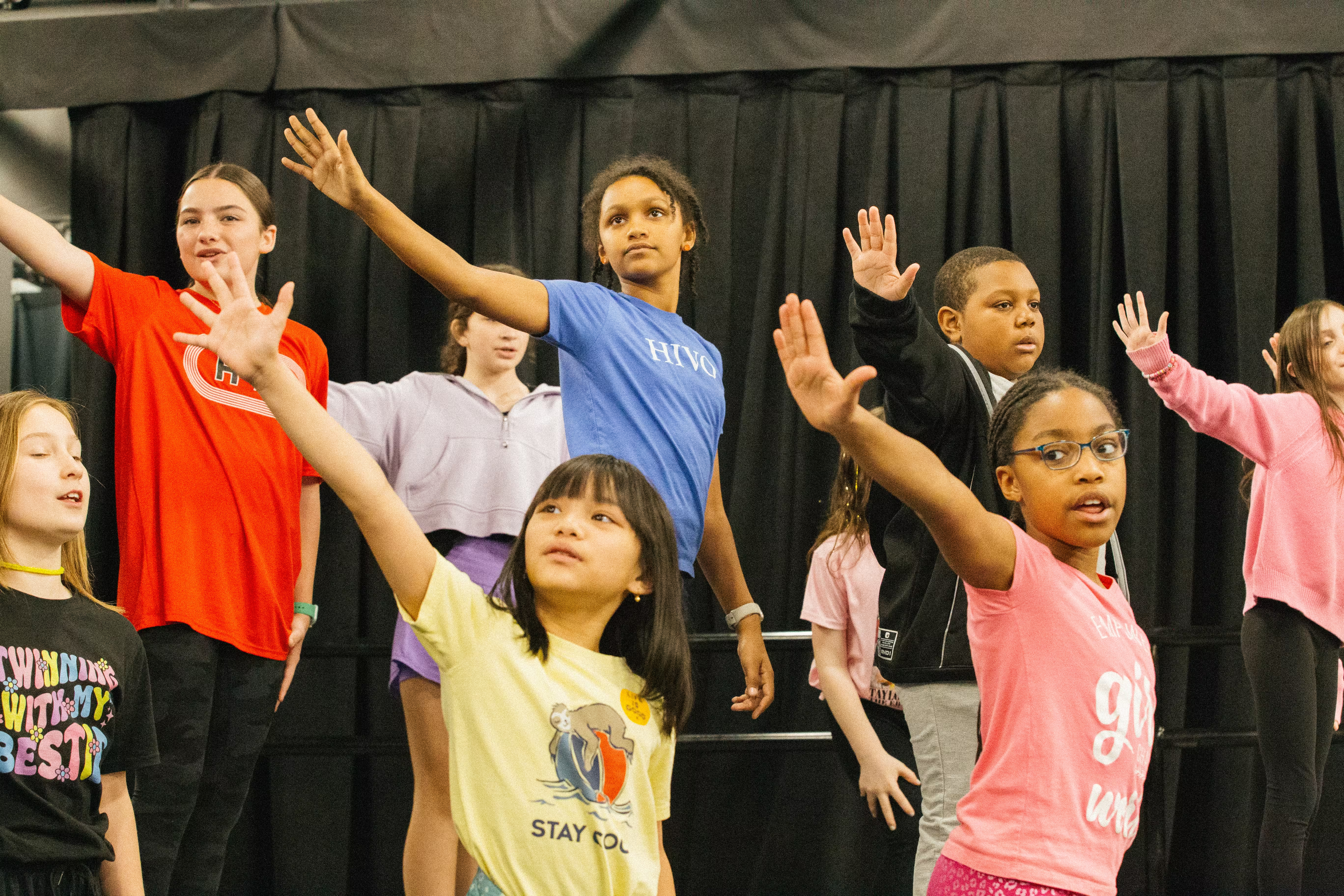
“Our camps attract ‘triers’, people who are testing out theater. Parents who might have a child who’s dramatic and they think theater camp might be a fit,” explains Drew. This means RMT needs to put in a concerted effort to turn those triers into repeat patrons, treating summer camps more like a pipeline than a standalone program. This is a group effort:
- Teaching artists and facilitators look out for campers who may be a fit for ensembles
- RMT’s youth performance director visits camps and shares about their other programs
- Staff introduce parents and students to future offerings at the end of each camp week
- The team sends personalized emails to help families find the next age- or skill-appropriate offering
Drew notes that parents also tend to start shopping early for summer camps in order to make sure their kids have something to do over the summer. RMT used to launch their summer camp catalog in February or March but in recent years, they’ve moved the launch earlier to December and January to meet parents where they’re at.
Summer camp best practices:
- Get your camps live early. Parents tend to start shopping for summer camps in January; aim for a go-live that meets that demand.
- Treat camps as an entry point. Make sure you have a nurture strategy in place to turn “trier” campers (and their families) into more consistent participants in your programs. This might include in-person interactions, email marketing, special offers, etc.
- Test tiered or dynamic camp pricing. Camps tend to be high volume programs which makes them a strong candidate for earlybird/standard/last minute pricing. Consider payment plans if access is a priority.
4) When testing new ideas, reduce risk, not ambition
Red Mountain Theatre continues to thrive because they continue to develop and test new ideas. These tests don’t always go exactly according to plan but staff have space to learn and iterate even when a test isn’t going well.
For example, Drew shared about a new program RMT launched this year called “devise camp”. Initially, it was designed as a two-week camp at a high price point. Students would audition, craft a play, and then perform it at the end of two weeks; the performance would be a ticketed event. They launched the program and… signups were low. Really low.

Rather than abandoning the idea completely, Drew and team decided to take a closer look and ask some important questions. First, they flagged that there wasn’t a brand name show to attract people (students were building something new). Second, they were asking for a two-week commitment in the middle of the summer. Third, they were offering the camp at a high price point even though it was a new program.
“In the end, we brought the duration down to one week. We decided to bring the price point down to attract more people so we could learn alongside participants. We softened the language so it was more about participation than auditioning. And now, there’s a waitlist for this camp and we can actually gather information and learn how to refine it next time,” shared Drew.
Considerations when testing a new offering:
- Pay attention to registration data. If signups are slower or lower than expected, consider how you can pivot before registration closes.
- Go back to your original goals: If it’s a new program and your main goal is to learn, consider how you can increase participation rather than focusing on increasing revenue.
- Adjust before abandoning a good idea. If your leaders believe in an idea or your community has asked for a particular program, diagnose and adjust before walking away completely. Consider: time commitment, price, prerequisites/auditions, clarity of outcomes, format, etc.
5) Make sure infrastructure keeps up with program growth
Red Mountain Theatre supports its growing education program in a variety of ways—and they’re committed to growing these resources as the program grows. This is critical; too many programs outgrow their systems and don’t get additional support, which hamstrings the program and stunts growth.
Staffing: RMT’s Artistic Director oversees the education program with support from an education coordinator, a youth performance director, two full-time teaching artists, and additional part-time teaching artists. The organization is currently considering hiring additional education leadership because the program has grown so much.
Technology: Red Mountain Theatre uses CourseStorm to support class registration and handle class-specific communication. CourseStorm integrates with their ticketing system, PatronManager, so all of their patron data is centralized in a single place. Leadership is continually on the lookout for manual processes that create friction for staff and families—and what’s needed to resolve that friction.
Steps to build supportive infrastructure for your education program:
- Simplify and streamline processes where possible. Create Standard Operating Procedures for regular tasks so staff don’t have to reinvent the wheel. Automate repetitive tasks that don’t require creativity with technology.
- Choose technology that simplifies life for staff and program participants. Look for “best-fit” solutions that are built for your day-to-day workflows, connected to your core systems, and don’t require extensive training.
Build your own growing arts education program
Red Mountain Theatre is able to grow their education program by prioritizing a few key things. They treat education as mission-critical, listen closely to their community, create pathways for continued participation, and give staff the support to test, learn, and improve. The result is a strong, sustainable program that supports their community impact goals.
While every organization and education program is unique, we believe any organization can benefit from these core tenets. Start with one area where your community or staff is experiencing friction, make a thoughtful change, and learn from the result. And when you’re ready to simplify registration, connect your systems, and build capacity for growth, CourseStorm can help. Talk to our team today.

Save time and grow your impact with CourseStorm

